Monday, 3 September 2018

Meeting Notes for July/August 2018


Meeting Notes July/August


In order to catch up on the meeting notes I have added August in with July. On both meetings we had  a good turn out, we had two entreating and informative quizzes from Irene who also supplied us with some goodies and the quiz rounds were also very informative. John, Moira, Val, Maureen and Peter read out the research work they had done which I will try and write up as soon as I can, the topics were quite diverse but none the less informative and entertaining some of them are included below.

We still have on the agenda a trip to the Railway Museum at Shotton, this had to be postponed because of the the groups holiday commitments. There are plenty of exhibitions and events coming up in September. Check out our members work below and if you have any comments or suggestion please get in touch.


Following our them of entertainment here is article from Iris about Pigeon Racing


 Pigeons have long been considered an archetypal Northern working class male sport or hobby. This is disproved by finding Queen Elisabeth has pigeon lofts and is keenly interested in pigeon racing. It has been an important part of male working class culture in northern industrial areas.

Wooden pigeon lofts, made from waste wood and painted in bright colours to attract the birds have long been part of the working class landscape. predominately on allotments. Historians have mostly overlooked this activity and therefore missed the opportunity to study something central to the history of working class culture.

Pigeons offered not only the thrills and excitement of racing, but also the more intellectual interest and skills of the breeders and the rearing of Doves - Pigeons are indeed Doves.

Gentle handling by the breeders is necessary to enable them to be trained, contrary to 'Racers' who discard ruthlessly if they fail to win. In 1760's fancying pigeons, birds butterflies and bees developed from an increased interest in natural fauna. By 19th century the natural world was less threatening and once man wasn't in a constant struggle with nature he could enjoy his doves. However  'fancying' gave way to racing due to mans use of birds for business rather than pleasure.

At the end of the Victorian period, King Leopold of Belgium gifted pigeons to the Duke of York and the Prince of Wales, who showed great interest in racing their birds. The 'Times@ in 1899 claimed @since the Prince of Wales won the race from Lowick it is shown by announcement in daily papers there is every indication the sport will become more popular.

Long distance racing developed a new more 'reptable clientelle' The Newcastle upon Tyne Homing Society formed in 1892 and not untypically it included local Business men, Doctors, Innkeepers and Colliery officials. Yest the majority of long distance racers before the First World War were probably working class.


By 1905 North Eastern trains ran 'Pigeon Specials', so popular was the sport carrying 7 million birds during the racing season! During the 'Great War' the service of pigeons was very valued. They are loyal creatures and 'Come home to root' some manging to return with bullet wounds.

In the 1920's a decent bird cost 25 Shillings though the best one record was £225! so obviously 'Family' did without a lot in favour of the pigeons which mus have caused immense stress in hard times.

The pigeon loft was, for the most part, an escape and also a masculine enclave, through for some an opportunity to share family time. Though though to be associated with flat capes and whippets, as signifies of the working class northern male, in reality its geographical base is far wider, None the less it was an important part of male working class culture in the late 19th century early 20th century.

For allot of working class families, open displays of emotion towards pigeons contracted uncomfortably with the more suppressed relations men showed their women or children. In 1934 as one racer put it 'We fanciers are deprived of the joy of following the course and cheering on, our own favourites. Anticipation is the sole quality that holds us magnetically in bounds of faith and hope, for we only see the final outcome of our own birds efforts. Aye1 and what emotions are aroused thereby !'

When this racer received the telegram announcing his bird had been released on their race, he felt 'a throb of exhalttation' When he saw his bird approaching, he became 'Transfixed, Electrified; almost simultaneously, upon the small platform at the entrance of the loft, 'There is the bird of his dreams.'


Our next meeting will be at our usual venue The Into Newcastle University Cafe, 10:30 Wednesday 12 September.


Monday, 30 July 2018

Meetings Notes for June 2018


Another good attendance for June at the Into Newcastle University Cafe. One of out topics for discussion was leisure activities during the early 19 century and we again had a great contribution from all that attended. Below you will find a selection of topics written by our members, more to follow in next months Blog. We also had a quiz from Peter and this has prove very popular to the extent that we will be having one each session form various quiz masters.


The Leek Club by Val


When the R.H.S was founded in 1804 its flower show set off a spate of similar events throughout the whole country. Improved living standards, increased leisure time, the development of the suburbs, public parks and botanical gardens as well as the Plant Hunters’ who searched the world for new species that commercial growers then made generally available all helped to stimulate a growing interest in hobby horticulture during the course of the nineteenth century.

Eventually virtually every city, town and village has its own particular version and one of the biggest and earliest took place on Bull Park in Newcastle in 1846. It was a grand affair with 'every accomodation' offered to visitors including music and refreshment. Admission to the show was one shilling, tickets for the Pavilion Dinner cost ten shillings and included a pint of wine.

Growers were keen to measure their achievements against those of their fellow enthusiast and in 1861 formal rules were set by the R.H.S for judging the quality of vegetables whereas in previous years the only criteria had been size.

Amongst the working classes in the North East there was an emphasis on showing leeks, an interest apparently due to a large influx of Welsh miners into the Northern coal fields and it became an important feature of the regions mining culture.  After a hard day underground the garden offered pit men fresh air and contact with the natural world. For those without gardens, tending allotments was viewed by many Victorians as a productive use of time by keeping the poor away from the evils of drink whilst at the. Same time providing wholesome food for the work force.

The Smallholding and Allotment Act of 1881 and further legislation in 1908 required local authorities to make land available for this purpose.

19 century leek growing was a science as well as a passion. Homemade fertiliser made from an assortment of slops left to stew was tipped into a jam jar at the base of the plant. The jar had its bottom removed by putting an inch of old engine oil into the jar, plunging a red hot poker into the oil and then lowering the jar into cold-water. The glass base dropped off leaving an open ended tube into which the fertiliser was poured. A roll of newspapers tied around the base of the growing plant kept the sun off and kept the base white. The blanched length of the leek could measure no more than 6 inches from its base to first leaf joint and an identical. Set of 3 was needed to stand any chance of winning a prize. Growers often slept in the garden, guarding their precious crop just prior to the showing season as sabotage was not uncommon.

The annual show was an important event involving months of planning and fund raising. As well as being a leisure activity the leek show gave the growers a sense of purpose with targets to aim. For and by offering a range of family attractions was a welcome source of entertainment for the whole of the community.

Ashington was sufficiently populated to support over 30 leek clubs. Small villages like Monkton, south of Jarrow had to co-exist with neighbouring societies. The origin of Monkton Society is not well known but it existed in 1864 as. The photograph of its committee illustrates. Membership of the most prestigious clubs was but invitation and it was said ' you would no more eat a prime leek than you would eat the winner of the derby.


Image from https://www.chroniclelive.co.uk/news/north-east-news/historic-cup-went-missing-82-13319949

Photo the leek show
Newcastle Horticulture show 1846


The Hopping’s. Moira


The Hoppings is an annual travelling funfair, held on the town moor in Newcastle upon Tyne, it is one of Europe’s largest travelling funfairs.

Hopping's were originally known as the Newcastle Temperance Festival, and today it is still a Temperance Festival, as there is no alcohol sold on the festival site. The Newcastle Temperance Society was launched on. The October 1 1839. Prominent in the Temperance movement was Dr John Hunter Rutherford, who was said to be a skillful and effective mouthpiece and was one of the original founders of the North of England Temperance League. After his death a drinking fountain was erected in St Nicholas Square, but was removed to make way for Queen Victoria’s Statue. Ironically his statue was then placed in the centre of the Big market. Famous for its number of public house and. Excessive use of alcohol

Due to a dispute between the corporation and Gosforth park racing company, the races moved from the town moor to Gosforth. In 1882,the largest travelling fair was launched on the town moor, by prominent temperance movement workers. It was designed to be a counter attraction to the drunken orgies of the Newcastle race meetings. Because of these races which included, betting, gambling, thieving and alcohol abuse, parents took their children away from the town during race week.

The fair started as a roundabout and freak show with temperance stands. It lasted two days and the rent income was £10 as compared to the rent income of £60,000 in 1991 For nine days.

During the first world war the fair moved to Jesmond Dene, bit returned to the town moor when the war ended. There were no fairs in. The city in the early 1920's,but they returned in 1924 and have continued since.

The Hoppings takes it name from an old word meaning to. 'dance' but there is also the suggestion that it may come from the clothing which the travellers wore, sack like tops and pants. This clothing often became infested with fleas, and people were seen 'jumping' and 'hopping' itching from the bites. The dance version is the one more widely accepted.

It is written in Geodie Folklore that when the hoppings came to. Toon, so does  a deluge of rain.


Leisure pursuits pre and post 1st World War Irene


The photographs show my mams mothers family the Pearsons. The photo with the wooden shed or maybe an old railway carriage was taken at Tarset around 1912.In the photo are my grandma aged 13, my great grandad Samuel Pearson, great uncles Sammy and jack Pearson, Jacks wife Georgina, great aunty Meggie and husband Tommy Siree, (killed in the 1st World War). The other photo shows great uncle Jack Pearson with brother Sammy and friends, this was also taken at Tarset, looks like there was some sort of competition going on. The wooden shed belonged to the Pearsons, it was well used in. Summer months by the family. As they were all working class I presume that it would be more used on a Sunday as they got very little time off work for leisure.


Tarset is four miles North West of Bellingham, in 1831 the population was just 169. Tarset was served by Tarset railway station on the Border Counties railway which linked the Newcastle and carlise railway near Hexham with the Border union railway at Riccarton junction. The first section of the route was opened between Hexham and Chollerford in 1858 the remainder opening in 1862, so this is one form of transport as to how the Pearson sand other people on the site got there.


I could not get any information about the site at this time, but obviously this type of leisure was pre caravan sites. In 1956 the railway was closed by British Rail, part of the line is now beneath the surface of Kielder Water. Tarset today is partly located within the Northumberland National Park and also within the international dark skies park, wonder what my Pearson family would have thought of that.


Music Halls Maureen

 
'Tyne & Wear Archives & Museums'


Music halls often began in an adjoining premises of a public house or in rooms set aside in the 1830's. By 1850's they had become so popular that the Tavern landlord had moved the entertainment into purpose built halls. A typical Music Hall bill would consist of 9-10 acts of different appeals. These would include trick cyclists, performing animals and impersonators. Comic vocalists singing the lyrics of many of Marie Loyd's songs such as 'She sits Among Her Cabbages and Peas' were also very popular. There was an. Entrance fee and a chairman would keep order using a gavel as he introduced the acts. The audience were able to consume food and alcohol as well as smoke Tobacco. The growth of the Hall were rapid. By 1870 there were 31 large Halls listed in London and 384 in the rest of the country. However there was a gradual decline by the end of the century when cinemas became more dominant.

The Music hall of 1838 in Nelson Stree built by Richard Grainger was a replacement for the one he had built on Blacket Stree in 1830. It was used for exhibitions, concerts and lectures. It was was known as the lecture Room and was where Charles Dickens read from his works. It changed its name to the New Concert hall in 1879 when it. Was recognised as a 'Music Hall'. From 1884 it was known as the Gaiety Theatere of  Varieties. It was taken over by the Temperance movement in 1890 and renamed it Central Hall. In 1911 it became a cinema. Most of the building was demolished in 1964 leaving the facade with  a tablet above the door.

The Wheat Sheaf Inn, 3 Cloth market was constructed in 1840. Its landlord John Balmbra. By 1848 a large roomon the first floor of the Inn was being used for concerts. By 1850 it was drawing crowds every night and known as Balbra's. Music Saloon. A new owner in 1884 changed it's name to Balmbra's Music Hall. This continued until it was renamed the Oxford Music hall when new owners took over in 1865. Around 1891it became the Oxford Restaurant and Public hall. The building was completely destroyed by fire in 1899.


Our Next meeting will be on Wednesday August 8 at 10:30 in the Into Newcastle University Cafe

Wednesday, 30 May 2018

Meeting Notes May

A warm and sunny day greeted us when we met at The Into Newcastle Cafe on 9 May. Another good turn out and some good research work done on the continuing story of Slavery in the North East. We also had a short quiz on Medieval History. Val brought in some work on the Legal status of slaves and on the Navigation Acts, Moira talked about the Slave Trade and its comparisons with the production of sugar and cotton. Shelagh related a storey from the Daily Mail about modern day slavery in Newcastle.


By Jos. A. Beard [Public domain], via Wikimedia Commons

Val continued here efforts at Slavery looking at the The Legal Status of Slaves in Britain.


Because slavery was such a lucrative business seen by many as essential to the British economy legal rulings on the subject were often ambiguous and open to conflicting interpretation. Central to the economics of the slave trade were the Navigation Acts which were based on monopoly principals designed to ensure that trade between Britain and her colonies was carried out only on British ships.


In 1677 an appeal was made to the Solicitor General to rule whether African slaves could be regarded as goods in conforming with the Navigation Acts controlling the regulation of trade. The Solicitor general rule unequivocally that as slaves were generally bought and sold they should be esteemed as goods and commodities.


Whether intended or not this ruling permitted salve owners to treat slaves as they would any other property. This process of dehumanising African men and women was reinforced when in 1729 the Solicitor general ruled that a salve coming to Britain did not become free and the master could legally compel him to return to the plantation despite the fact that English law gave every resident protection against illegal imprisonment or removal to a foreign country.


In 1769 James Somerset, the property of a Boston customs official named Charles Stewart was brought to England as a personal domestic slave.


In 1771 he ran away but was recaptured and placed on a ship bound for Jamaica where he was to be sold.


Anti slavery campaigner Granville Sharp took up his case and obtained a writ requiring him to be removed from the ship and brought before a judge.


In court Somersets legal team argued that although slavery was tolerated in the colonies English law did not allow a master to take a slave from England by force and sell him abroad because he had deserted his service.


On this occasion the Lord Chief Justice Lord Mandsfield agreed and describing slavery as odious ruled that Somerset must be discharged.

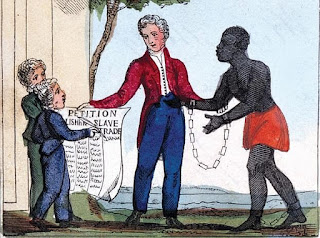
By Wesleyan Juvenile Offering [Public domain], via Wikimedia Commons


Abolitionists and slaves were initially overjoyed because the ruling was taken to mean that slaves residing in Britain were now emancipated, but this was not the case, the ruling was too narrow and slaves owners continued to capture runaways and return them to the colonies usually without legal challenge.


In 1785 Lord Mansfield further ruled that black slaves in England were not entitled to be paid for their labour, however, neither were they oblige to continue working for their masters as slavery was not within the bounds of contract law. Following the Abolition of the Slave Trade in 1807 greater clarification came when in 1824 the courts ruled that there was no statute recognising slavery in Britain. The public widely understood this ruling to mean that on English soil at least no man or woman was a slave but in legal terms the status of slaves in Britain was still unclear.


Mary Ann Macham who came to England as an escaped slave arrived in North Shields from Virginia on Christmas day in 1831. Her mother was  to slavery rather than the freedom she enjoyed in the North east of England.a slave, her farther the slave owner. She was 29 years old and this was her first day of freedom.


She had crossed the Atlantic on an English ship, the Atlas, heading for Grimsby but the ships mater brought her to Tyneside. How she came to be aboard the Atlas is unclear. She may have bought a passage herself or been supported by the 'undereground railway' who helped 10,000 people flee the southern states.


Mary Ann found refuge with the Spence family, North Shields, Quaker bankers and drapers. She worked in domestic service until 1841 when at the age of 39 she married James Blyth a local rope maker. The couple had no children and some time later James died in 1877. Mary Ann moved in with her relatives of her late husband in South Benwel.


In 1893 at the age of 91 Mary Ann died and was buried in Preston Village. She had arrived in England 2 years before the Abolition Act was passed. Had her master pursued her she might well have been forcibly returned to Virginia and condemned to slavery rather than the freedom she enjoyed in the North East of England.


Shelagh related and article in the Daily Mail in April 2018 entitled a Business Built around Slavery.

The following took place in a  large old Edwardian house in Newcastle West End, the £225,000 pound property was rented by a Roma family from Slovakia who began their slave business in 20110. The perpetrators were all from one family who exploited the EU freedom of movement law; to traffic victims from Slovakia and the Czech Republic to their house in Newcastle. The Roma family known as the Rafaels paid a trafficker back home £300 for each victim that was sent to them in Newcastle.

The victims were from the poorest in society, some were homeless and living on the streets, none spoke English, they were promised a really good life in the U.K. if they were prepared to work hard. One of these poor vulnerable men and women arrived and were in the clutches of the Rafael family their passports were taken off them and they were told that if they ever went to the police to complain there was no hiding place, they would be found and suffer a horrendous death as would any family that they had back home.

The living conditions for those people was horrific, they lived in absolute squalor, they were given meagre amounts of food usually way past its sell by date.

The Rafaels used government agencies to find jobs for their victims, some of these jobs were in car Wash facilities or food packaging units, one man who worked twelve hours a day, received £10 a day as the Rafaels took the rest of his earnings from him. The Rafaels not only claimed fraudulent amounts of money for themselves but also for their victims. The Rafaels were living a life of luxury on the backs of their poor victims.

The bubble burst for the Rafaels when one of their victims went to the police.

The Rafaels were arrested and charged with slavery, trafficking, money laundering and fraud. The six Rafaels were given a jail sentence of thirty eight years between them and will be deported when their sentence has been served. The victims or slaves have now all been returned to Slovakia and the Czech Republic.

It is hard to believe that in the 21st century in our little corner of the world all this has been going on under our noses and none of us knew.


Moira talked about the Slave Trade and its comparisons with the production of sugar and cotton.


In the mid 17 century sugar cane was brought into what became the British West Indies by the Dutch from Brazil. Because of stiff competition from North American colonies the price of cotton and tobacco had decreased. Therefore the local growers were urged to change to sugar cane, this led to a boom in the Caribbean economics.

In 1807 annual incomes per estate of $4000 ($400,000 today) was not uncommon for sugar planters. The extreme cost was paid by enslaved Africans, whose working conditions were horrendous. They were made to work so hard that the labour force had to be renewed every decade due to the high death rate amongst the slaves. They were literally worked to death. The sugar islands became grave yards for the slaves.
By Amelia Opie(Life time: 1769-1853) - Original publication: book = "The Black Man's Lament, or, how to make sugar" by Amelia Alderson Opie. (London, 1826).Immediate source: http://www.historyextra.com/slavery. See original file in the British Library, Shelfmark T.1271.(2), http://www.bl.uk/onlinegallery/onlineex/carviews/t/022zzz000t12712u00002000.html, https://en.wikipedia.org/w/index.php?curid=44107588


Children were made to work the plantation crops from as young as five and on many plantations women were made to work throughout pregnantcy, their babies were raised in nurseries whilst their mothers worked all the daylight hours in the field. The owners used extreme violence on the enslaved labourers and the violent treatment is documented in narratives by Olaudah Equiano, Mary Price, Robert Wedderburn and Frederick Douglass. Despite the horrendous conditions, they tried hard to keep their humanity and dignity. An example of the sort of treatment can be found in the diary of Thomas Thistlewood an overseer on Egypt plantation which was west of Savanna la Mar in Jamaica, his sexual exploitation and treatment of the slaves under his charge is referred to by historian Trevor Bernard as being a brutal sociopath.

When freedom from slavery ended in the British Caribbean in 1838, the British continued to work the plantations using a new labour force brought from the Indian subcontinent. The Indian labour was called an indenture labour force. The workers came under a contract( an indenture), but under this contract they rarely made any money from their labour, despite long hours and tough conditions.
Between 1838 and 1918 over 1.5 million workers came from Asia to the British Caribbean alone. This contradicted British claims that they had been morally good in abolishing enforced labour regimes.


Our Next Meeting will be on Wednesday 13 June 10:30 at the Into Newcastle Cafe


Monday, 7 May 2018

Meeting Notes April


Our new venue is proving  popular with our members with another good turn out even though it was half term. Last month we mentioned a possible project about Slavery and its connections to Newcastle, we have had several diligent members look into this and we had quite a good discussion. Some of their work can be seen below. We are also looking to continue this for our next meeting. Planned for our next meeting is a short quiz about the Medieval Period which in Europe began with the fall of the Western Roman Empire and lasted from the 5th to the 15th century Merging into the Renaissance and the Age of Discovery. Thinking caps on!


Michael replied to Mike Combes reference to German Pork Butchers in the North East. Its great to see Local History relived in peoples memories, talks and images.

Very interesting and excellent work.  There was a German pork butcher family in Consett, spanning over 100 years, surname Yager.  It was a very popular business from I think the 1880's and was well renowned for their pork sandwiches.

The business is still in operation now and has kept the original name and is located on Victoria Road, however.,the Yager family are no longer involved having retired approx 3 - 4 years ago.

I feel the Yager family business was an important part of Consett's social and retail history adding culture, diversity and real tasty food - ham, pease pudding, saveloys and pork sausages were real favorites.


Kind regards

Michael

Moira collected some interesting facts about the Slave connections in the North East:
One of the first North East connections with slavery was William Hylton who belonged to a Sunderland family with ancient roots. Through an association with Sir Edwin Sandys a counsellor of James 1, he went to New England as part of a rescue mission for the Mayflower Settlers. He was the first settler in what became New Hampshire. There are a number of County Durham place names in this area, which suggests that more North Easterners were attracted to the area. Anthony Hylton a relative followed in 1623. He acquired a tobacco plantation and was appointed governor of St Kitts and Nevis in 1625. Hyltons descendants settled in Maryland Carolina and Jamaica before 1700. Like many of the first settlers, involvement in the slave trade and slavery grew out of acute labour shortages in their new lands. Members of several North East families were early arrivals in America and the Caribbean, the Pinkneys of West Auckland, the Howards of Brampton, the Corvilles of Newcastle and branches of the Northumbrian Fenwicks, Ogles and Ordes.
During the 18th Century, many of the regions gentry had acquired colonial interests. Among the most significant were the Trevelyan's of Wallington Northumberland. Sir John Trevelyan had married Louise Marianne daughter of West Indian Merchant, Peter Simond and became a plantation owner. By the time of the abolition of slavery in 1833, the family had become major sugar producers in Granada, they were paid £35,000 in compensation for the loss of slaves under Parliaments compensation award.
There were a number of attempts to abolish slavery and the North East took the lead in numerous meetings and petitions. On Thursday May 15 1828 a meeting was held in the Newcastle Guild Hall, amongst professional clerymen. They advocated the gradual rather than the immediate abolition of West Indian Slavery. James Losh a lawyer, reformer and Unitarian, believed this would protect the trade and property of slave holders, secure the empire to Britain and give time for education and missionaries to prepare slaves for freedom.
One speaker said the idea of 800,000 of our fellow subjects being doomed to interminable slavery, is most revolting to every hum and mind, but he also said 'our object is not to injure the property of the planters, but to protect it and not to excite to rebellion but to prevent it.' They also seemed to have been fired by a missionary agenda.
In 1834 the British government replaced slavery with a system of apprenticeship. Losh and his colleagues would have welcomed the fact that slaveholders were compensated for loss of their propery-slaves by the British tax payer. In 1853 William Wells Brown, who had been a slave in the US, visited Newcastle and remarked on the kindness of Geordies, he is quoted as saying, 'in no place in the United Kingdom has the American slave warmer friends than in Newcastle 

Maureen found some  more interesting local facts:

Every town and city had anti-slavery societies, Newcastle was no exception. Women were involved almost from the beginning. Amongst the area's most enthusiastic supporters was the Richardson family. They founded 25 groups of both working and middle class families, 13 of which were in the North East. A petition was presented in Parliament in 1822 signed by 5,956 people from Newcastle and Gateshead demanding the abolition of West Indian Slaves.
Anna Atkins was born in Chipping Norton and educated in West Yorkshire, she married Hery Richardson a fellow student at the Society of Friends Ackworth School, they settled in Newcastle along with hery's sister Ellen. They worked closely with their American campaigners, The Newcastle Ladies Emancipation Society was revised by them. Anna Richardson served as a prison visitor and worked to aid refugees. The Richardson were friends and mentors to Frederick Douglass who was born a slave February 1818 in Talbort County Maryland. Frederick Douglass was a social reformer, abolitionist, orator, writer and statesman. There were concerns for him that his owner would re-enslave him as soon as he returned to the US. Anna and Ellen announced a meeting in Edinburgh October 29 1846 of  activists to raise money to legally Free Douglass from his owner, £159 was raised. In December 1846 papers were filed in the USA which gave the escaped slave freedom from his owner Thomas Auld. The decision to buy Douglass's Freedom was not without critics; they felt it legitimised the idea any human being could ever be owned by another to be bought and sold like property.

On the 50th anniversary of Martin Luther Kings visit to Newcastle to receive an Honoury Doctorate in 1967, a plaque was unveiled as a tribute to Douglass and the Richardsons Family in Summerhill Grove Newcastle. The Richardsons had four houses in Summerhill Grove interconnecting with each other where Douglass stayed for a short time. He said the two ladies Anna and Ellen were instrumental in giving him a chance of devoting his life to freedom. The plaque contains one of Douglass's quotes:

I would unite with anybody to do right and with nobody to do wrong.


Val provided us with some interesting print outs from the following web sites:


 SEGEDUNUM ROMAN FORT


Our next meeting will be at the Into Newcastle Cafe, part of Newcastle University opposite the Haymarket Bus Station. We will be meeting up on Wednesday 9 May 10:30, we will be continuing the Slavery in The North East project and we will have a generic quiz on the Medieval Period.